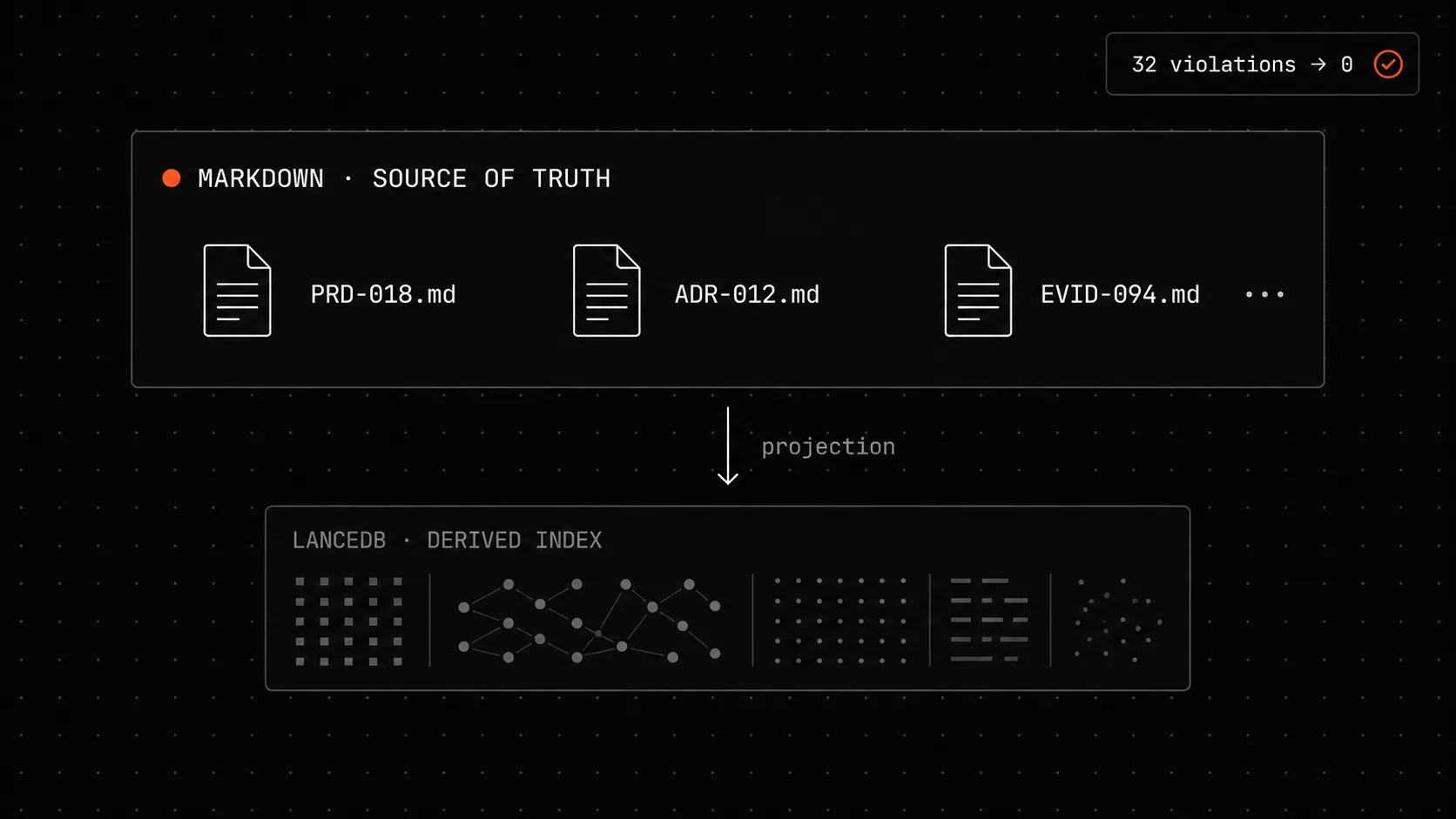
How ForgePlan's load-bearing ADR-003 invariant got compile-time-enforced: 4 audit rounds, 56 findings, a pub(crate) lockdown across 32 call sites, and why the boring discipline matters more than clever architecture.
The invariant in one sentence
In ForgePlan, markdown files in .forgeplan/{prds,adrs,specs,rfcs,evidence,...}/*.md are the source of truth. The LanceDB index is derived and rebuildable.
Every artifact mutation flows from markdown into LanceDB, never the reverse. If LanceDB and markdown disagree, markdown wins, and forgeplan scan-import rebuilds LanceDB from the on-disk files.
This is ADR-003. It’s the single most load-bearing architectural decision in the project. It’s also the one we almost lost - twice.
This is the story of how the invariant got compile-time-enforced, what it took (4 audit rounds, 56 findings, a pub(crate) lockdown across 32 call sites), and why the boring discipline matters more than the clever architecture.
Why one-way
Two-way sync between markdown and a vector DB is a tar pit. The failure modes are:
- Stale index - someone edits the markdown directly (or
git pullbrings in changes from another agent), the index doesn’t know, semantic search misses results. - Stale markdown - code path mutates the index without writing the markdown, the file becomes a fossil,
git difflies, code review can’t catch the drift. - Conflict on regenerate - index has data the markdown doesn’t, regeneration overwrites it, work is silently lost.
We picked one-way: markdown is authoritative, LanceDB is a cache. The cache can be deleted at any time and rebuilt with forgeplan scan-import. This is also why .forgeplan/lance/ and .forgeplan/.fastembed_cache/ are gitignored - they’re derived artifacts.
The CLI and MCP server enforce this through a single discipline: never call LanceStore::create_artifact / update_* / delete_* / add_relation / delete_relation directly from commands/*.rs or server.rs. All mutations go through forgeplan_core::projection::sync_file_to_store and render_projection.
That’s the rule. It’s a one-line rule. It would not survive contact with a 12.8K-LOC codebase touched by AI agents and human contributors over six months. So.
How the rule failed (PROB-048)
Six weeks ago I ran an audit asking “how many places call LanceStore::* mutators directly?” The answer was supposed to be zero.
It was 32.
Thirty-two places in commands/*.rs and server.rs were doing direct LanceStore::create_artifact(...) or LanceStore::add_relation(...) calls. They were spread across history; some were copy-paste from earlier patterns; some were “just for this one edge case”; one was a debug helper that nobody removed.
Each violation was a quiet bomb. None of them caused immediate breakage, because the markdown writes and the LanceDB writes happened in the same commit. But they meant: the projection invariant existed in the original author’s head and nowhere else. New code, written by a new agent or a new contributor reading the existing patterns, would inherit the violation as the norm.
I logged this as PROB-048. I scoped a fix as PRD-073, with three phases:
- Phase 3a - refactor all 32 call sites to go through the projection helpers
- Phase 3b - introduce 15 helper functions wrapping the canonical flows
- Phase 4 - flip the visibility of the dangerous
LanceStoremutators topub(crate)so the compiler refuses to letcommands/*.rsever call them again
The four audit rounds
Refactoring is the easy part. Refactoring without regression is the hard part. I ran four adversarial audit rounds, each with two AI agents (a security reviewer and a code reviewer), each instructed to find at least three issues. Zero findings = re-spawn (suspect superficial review).
Round-by-round:
| Round | Findings closed | What broke |
|---|---|---|
| R1 | 19 | Initial refactor missed 7 sites; 12 helper signatures didn’t match call-site needs |
| R2 | 18 | pub(crate) flip exposed 11 unit tests that imported LanceStore directly; 7 doc examples broke |
| R3 | 13 | Edge case in forgeplan_link - relation deletion path bypassed the projection helper |
| R4 | 6 | Final cleanup; one dead function in journal/, two stale doc comments |
| Total | 56 | - |
The regression guard sealed it. tests/adr_003_invariant.rs is a single integration test that walks the source tree, counts direct LanceStore::create_artifact / update_* / delete_* calls in commands/ and server.rs, and fails the build if the count rises above the floor (currently 0). It’s ten lines of code. It is the single most important ten lines in the repo.
The compile-time piece (pub(crate)) blocks new violations. The runtime test (the regression guard) blocks regressions in case someone adds a new module under commands/ and forgets the rule. Belt and suspenders.
Why I’m telling this story
Three reasons.
One: invariants without compile-enforced guards are folklore.
ADR-003 was written on day one of the project. It was clear. It was correct. It was 32-times violated within six months. Any architectural document that relies on “we’ll all remember the rule” loses to entropy. The interesting question isn’t “what’s the right invariant” - it’s “how does the build break when someone forgets the invariant?” If the answer is “it doesn’t,” your invariant is decorative.
Two: AI-augmented codebases need this discipline more, not less.
When you spawn parallel sub-agents to refactor or extend a codebase, each agent has a context window and a partial view. The agent reading existing patterns doesn’t see ADR-003 unless you put it in the agent’s prompt. And even then, “remember the rule” is a fragile commitment when the agent is making 50 file edits in one pass. The compiler is the only reviewer that doesn’t get tired or distracted.
This is why ForgePlan’s CLAUDE.md has explicit red lines and why every multi-agent dispatch in our cohort assigns explicit file-ownership grids. The cost of letting an AI agent freelance on architectural invariants is paid weeks later, when the next agent reads the freelanced code and treats it as canon.
Three: dogfooding stress-tests the methodology.
The whole point of ForgePlan is “every decision leaves a trail.” PROB-048’s resolution lives in .forgeplan/problems/PROB-048-*.md. PRD-073 is in .forgeplan/prds/. The four audit-round summaries are EvidencePacks. EVID-094 (the closing pack) scored R_eff=0.80, grade A. That’s not perfect; one piece of evidence on the post-Phase-4 fuzz benchmark hasn’t been re-run since v0.28. The decay is honest. The artifact graph reflects it.
When I teach this story in the cohort, I run forgeplan get PRD-073 live. The students see the FRs marked complete, the linked EvidencePack, the R_eff score, the closing note. The methodology is not a slide deck. It’s the file the tool reads.
What changed for the codebase, concretely
Post-Phase-4, the forgeplan-core::store module looks like this:
- All
create_*,update_*,delete_*,add_relation,delete_relationmutators arepub(crate). - 15 helper functions in
forgeplan_core::projectionwrap the canonical flows:sync_file_to_store,render_projection,apply_link_change, etc. - The canonical CLI command for a one-shot mutation is
crates/forgeplan-cli/src/commands/deprecate.rs- 40 lines, no direct store access, every step routed through projection. - New contributors get a compile error on day one if they try to shortcut.
- The regression guard is part of every CI run.
cargo test ran 1995 tests at the time of writing, 0 failures, 0 warnings on both feature configurations. The lockdown didn’t slow anything down measurably; it removed an entire class of bugs.
What I’d tell another founder building methodology tooling
If you only take one thing from this post: the rule is enforced by the compiler or it’s not enforced.
Documentation is necessary but not sufficient. Code review catches some violations. CI tests catch more. But if a senior contributor or an AI agent can write code that compiles and ships while breaking the invariant, that invariant will erode. The only way to preserve it across a year of changes is to make it physically impossible to violate.
pub(crate) is one of the cheapest, most underused features in Rust. It cost me ten minutes of typing and saved an entire architectural layer.
The cost of the four audit rounds was real (about three weeks of wall time, mostly running adversarial reviews and closing findings). The cost of not doing this work would have been a slow drift back into 50-violation territory by month nine, at which point untangling it becomes a multi-month project instead of a multi-week one.
This is the boring discipline. It’s also the difference between a tool that survives its second year and one that quietly rots.